ANA and Japan Airlines Urge Coordinated Action to Scale Sustainable Aviation Fuel and Protect Japan’s Air Transport Future
(IN SHORT) All Nippon Airways and Japan Airlines have released the second edition of their joint report, Toward Net Zero CO2 Emissions from Air Transport in 2050, outlining the current state of sustainable aviation fuel in Japan and the actions needed to support aviation decarbonisation. The report warns that SAF remains far below the level required to meet aviation’s 2050 net-zero goals, accounting for only 0.6% of global aviation fuel consumption in 2025. ANA and JAL argue that production must increase and costs must fall within the next five years to avoid serious social and economic impacts. The report also highlights aviation’s importance to Japan’s economy, regional communities and inbound tourism ambitions, noting that the sector generates around 17 trillion JPY in annual economic activity. The airlines call for a Japanese model that balances SAF regulation with domestic production capacity, alongside a society-wide co-creation approach in which companies and customers help support SAF deployment through Scope 3 emissions reduction programmes.
(PRESS RELEASE) TOKYO, Japan, 2026-May-26 — /Travel PR News/ — All Nippon Airways and Japan Airlines have released the second edition of their joint report, Toward Net Zero CO2 Emissions from Air Transport in 2050, calling for a society-wide approach to accelerate the use of sustainable aviation fuel and support the decarbonisation of Japan’s aviation sector.
The report examines the current state of sustainable aviation fuel in Japan and outlines the actions needed to help the air transport industry reach net-zero carbon dioxide emissions by 2050. It highlights the urgency of scaling SAF production, reducing costs and building a coordinated framework involving airlines, government, fuel producers, businesses, customers and wider society.
ANA and JAL describe SAF as essential to aviation’s long-term decarbonisation pathway. However, the report notes that SAF accounted for only 0.6% of global aviation fuel consumption as of 2025. Without a significant increase in production capacity and reductions in cost over the next five years, the aviation industry could face major challenges in meeting its emissions targets without broader social and economic consequences.
The report also stresses the economic and social importance of aviation in Japan. The country’s aviation sector is estimated to generate around 17 trillion JPY in annual economic activity. Stable fuel supplies are therefore critical not only for decarbonisation, but also for maintaining regional connectivity, supporting remote island communities and helping Japan achieve its goal of attracting 60 million inbound visitors.
ANA and JAL are advocating for a tailored Japanese model that aligns the pace of SAF regulation with the development of domestic SAF production capacity. This approach is intended to avoid supply-demand imbalances, reduce the risk of excessive cost burdens and support sustainable long-term growth for Japan’s aviation industry.
The two airlines are also promoting a co-creation model linked to customers’ Scope 3 emissions². Through programmes³ such as ANA’s SAF Flight Initiative and JAL’s Corporate SAF Program, the airlines aim to enable corporate customers and other stakeholders to participate in reducing emissions associated with air travel. This model is designed to distribute the high cost of SAF implementation more broadly across society rather than placing the burden solely on airlines.
ANA and JAL said their collaboration reflects the need for a unified industry approach. As the two major carriers supporting Japan’s aviation network, the companies are working beyond competitive boundaries to protect the long-term sustainability of air transport and support the continued growth of the Japanese economy.
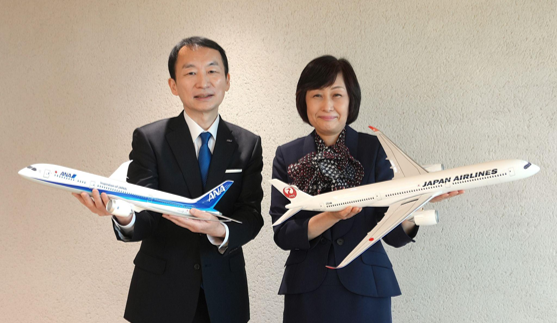
Juichi Hirasawa, President and CEO of ANA, said domestic SAF implementation has begun to gain a foothold thanks to stakeholder support, but warned that the global SAF environment remains extremely challenging. He said delays in securing fuel now represent a direct risk to Japan’s economic security and called for an effective society-wide framework to maintain aviation infrastructure and pass sustainable skies to the next generation.
Mitsuko Tottori, President and Group CEO of JAL, said aviation has a vital mission to continue enabling human connections and social well-being through the movement of people. She noted that while scaling SAF presents significant challenges, JAL remains committed to advancing a sustainable future for aviation together with ANA, customers and stakeholders.
The second joint report follows the first ANA and JAL report on SAF released in October 2021, continuing the two airlines’ shared effort to build a practical roadmap for carbon-neutral aviation in Japan by 2050.
The report follows the first joint SAF report released in October 20211.
1 October 8, 2021 press release: [ANA and Japan Airlines Towards 2050 Carbon Neutral Joint Report on SAF]
2 ANA “SAF Flight Initiative” Details URL: https://www.ana.co.jp/en/jp/brand/ana-future-promise/saf-flight-initiative/ |
JAL “JAL Corporate SAF Program” Details URL: https://www.jal.com/ja/sustainability/jcsp/
3 Under the GHG Protocol, an international standard jointly developed by the World Resources Institute (WRI) and the World Business Council for Sustainable Development (WBCSD), corporate CO2 emissions are classified into three categories:
Scope 1: Direct CO2 emissions from a company’s own business activities.
Scope 2: CO2 emissions from energy sources supplied by other companies, such as electricity or heat consumption.
Scope 3: Indirect CO2 emissions from a company’s business activities (e.g., product transportation, employee commuting, and business travel).
Contact:
Corporate Communications, All Nippon Airways Co., Ltd, TEL +81-3-6735-1111, publicrelations@ana.co.jp
Corporate Communications, Japan Airlines Co., Ltd, mediarelations.hdq@jal.com
About All Nippon Airways (ANA)
Founded in 1952 with just two helicopters, All Nippon Airways (ANA) has grown to become Japan’s largest airline and a global leader in premium service.
ANA operates an extensive international and domestic network, connecting destinations across Asia, North America, Europe and beyond. With a focus on quality and omotenashi, ANA delivers a consistently high standard of service across every stage of the journey.
ANA is the only Japanese airline to have earned SKYTRAX’s 5-Star rating every year since 2013, underscoring its consistent excellence. The airline is also a four-time recipient of the Air Transport World’s (ATW) Airline of the Year award. In 2025, ANA was honored with FlightGlobal’s Executive Leadership: Asia-Pacific Award, reflecting its continued focus on innovation and strategic growth.
As part of ANA HOLDINGS Inc., ANA continues to invest in the onboard experience, its fleet and digital services to enhance the travel experience for passengers worldwide.
For more information about ANA and ANA HD, please visit: https://www.ana.co.jp/group/en/
About Japan Airlines (JAL)
Japan Airlines (JAL), Japan’s first private aviation company, was established in 1951 and is a member of the oneworld® Alliance. The airline operates a fleet of 234 aircraft (as of March 2026) and began renewing its international long-haul aircraft with the Airbus A350-1000 starting 2023 Winter Schedule. Together with other JAL Group and partner airlines, JAL offers an extensive domestic and international network that serves 413 airports across 71 countries/regions.
The airline has received numerous accolades for its exceptional service, including being recognized as a certified 5-Star Airline by Skytrax and being awarded the prestigious “World Class” Airline title by APEX, the Airline Passenger Experience Association. The airline is dedicated to ensuring the highest standards of flight safety and overall service quality, striving to be the most preferred airline by customers worldwide.
For details and to learn more, visit JAL’s official website at https://www.jal.com/en/
SOURCE: ANA HOLDINGS INC.