(NEWS) BANGKOK, Thailand, 2026-May-19 — /Travel PR News/ — In an industry built on movement, adaptation has become one of tourism’s most valuable currencies.
Across Asia and the Pacific, tourism professionals are navigating a rapidly shifting landscape shaped by artificial intelligence, sustainability targets, changing traveler expectations, digital marketing demands, and mounting pressure to balance growth with responsibility. For many small tourism businesses, independent operators, and even government agencies, keeping pace with that transformation can feel less like optional professional development and more like survival training for the future of travel.
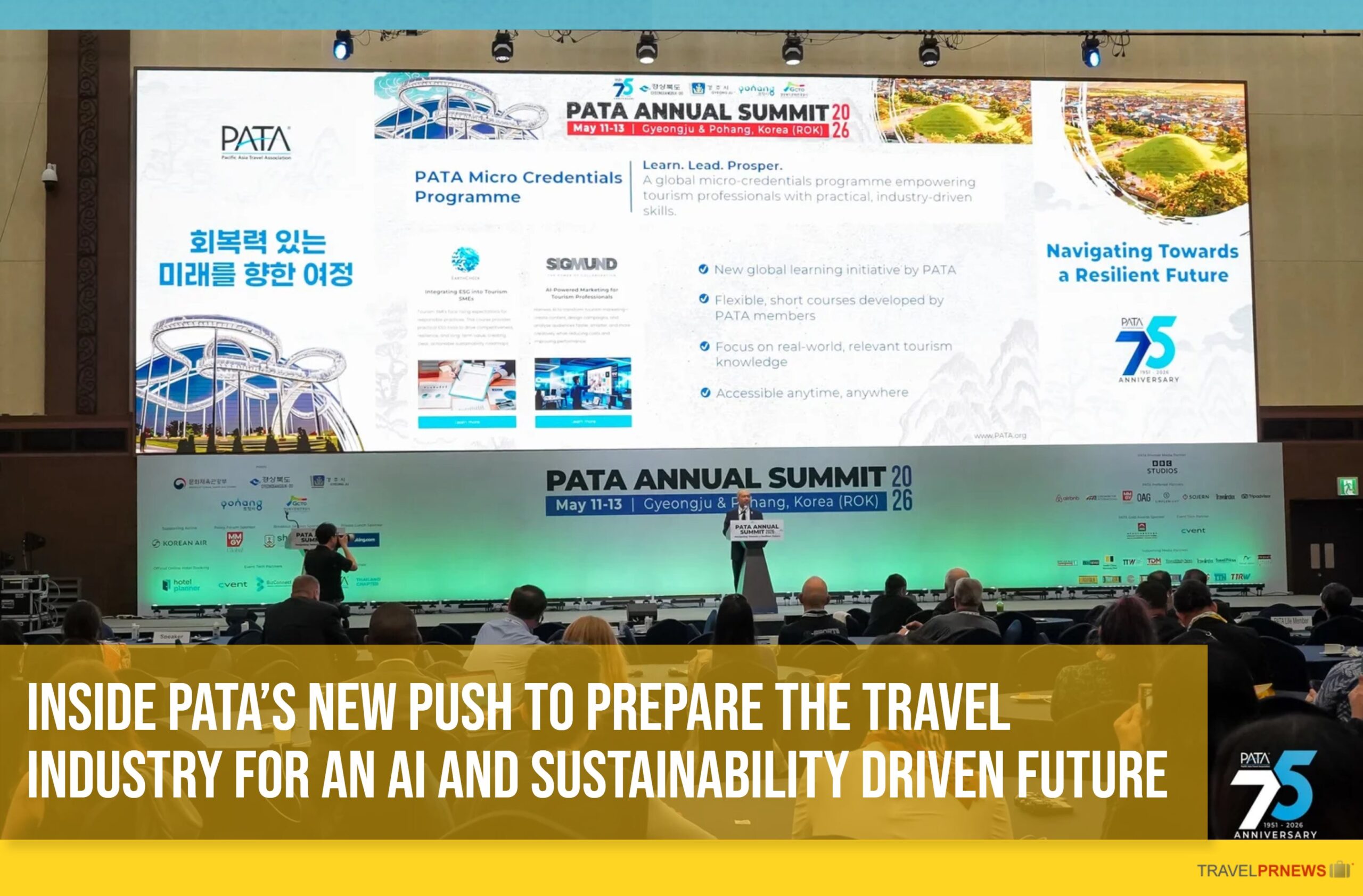
That urgency formed part of the backdrop at the recent PATA Annual Summit 2026 in Gyeongju, South Korea, where the Pacific Asia Travel Association unveiled a new learning initiative aimed at helping tourism professionals sharpen practical, industry-relevant skills in a more flexible way. According to a press release published by PATA, the newly launched PATA Micro-credential Programme will offer short-form online courses focused on emerging tourism challenges and operational realities facing the sector today.
The concept reflects a wider shift occurring across global tourism and hospitality, where traditional career pathways are increasingly being reshaped by fast-evolving technologies and sustainability expectations. In a sector historically built around operational experience and interpersonal skills, professionals are now expected to understand everything from ESG frameworks and AI-driven marketing tools to climate-conscious business models and digital content production.
For smaller tourism businesses especially, formal long-term education programs often remain financially or logistically difficult to access. Micro-credential programs — shorter, targeted learning modules focused on practical application — have rapidly gained popularity across industries as a more adaptable alternative to traditional professional training.
Hosted through PATA’s Skills and Resource Centre platform, the new initiative is designed for a broad audience ranging from entry-level tourism workers and entrepreneurs to SMEs, tourism boards, and government organizations. Participants complete courses at their own pace and receive digital certifications upon completion, offering a more flexible format suited to the fragmented schedules and geographically dispersed nature of the tourism workforce.
The first wave of courses reveals where many of the industry’s current anxieties — and opportunities — are concentrated.
One programme, developed with EarthCheck, focuses on integrating ESG principles into tourism SMEs. Rather than framing sustainability as abstract corporate policy, the course emphasizes practical and affordable operational changes that smaller businesses can implement to improve environmental and social performance while also increasing efficiency.
That focus mirrors broader trends within tourism, where sustainability is increasingly moving from marketing language into operational necessity. Travelers are paying closer attention to environmental practices, while destinations across Asia-Pacific face growing pressure from climate impacts, resource management concerns, and changing regulatory expectations.
The second inaugural course, created by The Sigmund Project, tackles another major disruption reshaping the industry: artificial intelligence.
AI tools are rapidly transforming how travel brands create advertising campaigns, produce content, manage customer communication, and market destinations online. For many smaller tourism businesses that previously lacked large in-house marketing teams, AI has opened new possibilities for faster and cheaper content production — while also introducing uncertainty about how to compete in an increasingly automated digital environment.
The course focuses on helping tourism professionals apply AI tools directly to marketing workflows, branding materials, advertising production, and campaign development in ways designed to save time and reduce operational costs.
The launch also underscores the growing importance of continuous learning within tourism itself. Unlike industries where technical certifications remain static for years, tourism increasingly requires professionals to evolve alongside traveler behavior, digital trends, sustainability frameworks, and geopolitical shifts that can reshape destinations almost overnight.
For Noor Ahmad Hamid, the initiative appears closely tied to PATA’s wider role as both an industry convener and knowledge-sharing platform across Asia-Pacific tourism markets. Speaking during the summit, he emphasized the importance of accessible and collaborative learning in helping tourism stakeholders adapt collectively rather than in isolation.
The setting for the launch — the ancient Korean city of Gyeongju — offered its own subtle symbolism. Often described as a living museum for its centuries-old temples, royal tombs, and cultural heritage sites, the city embodies the intersection between preserving tradition and embracing modernization that many tourism destinations across Asia are now trying to navigate.
And perhaps that tension defines tourism’s next chapter more broadly.
As the industry rebuilds and redefines itself in the years following massive global disruption, the most valuable travel skills may no longer be tied solely to destinations, operations, or customer service alone. Increasingly, they revolve around adaptability — learning how to respond to technological acceleration, environmental pressures, and changing traveler expectations in real time.
For tourism professionals across the Asia-Pacific region, that future may now begin not in a conference hall or classroom, but through a short digital course completed somewhere between flights, hotel check-ins, and the next evolving challenge facing the global travel industry.
(NEWS) SHANNON, Ireland, 2026-May-20 — /Travel PR News/ — Young people from across County Clare were…
(IN SHORT) Accor is launching the second edition of the HERA Challenge, inviting members of…
(IN SHORT) Zoo Atlanta’s Brew at the Zoo will return on Saturday, May 23, 2026,…
(IN SHORT) Emirates has completed the first retrofit of a two-class Airbus A380 aircraft as…
(NEWS) BANGKOK, Thailand, 2026-May-20 — /Travel PR News/ — As Africa Day approaches, hotel groups across…
(IN SHORT) World Travel Awards has selected Hyatt Regency Kotor Bay Resort in Montenegro as…