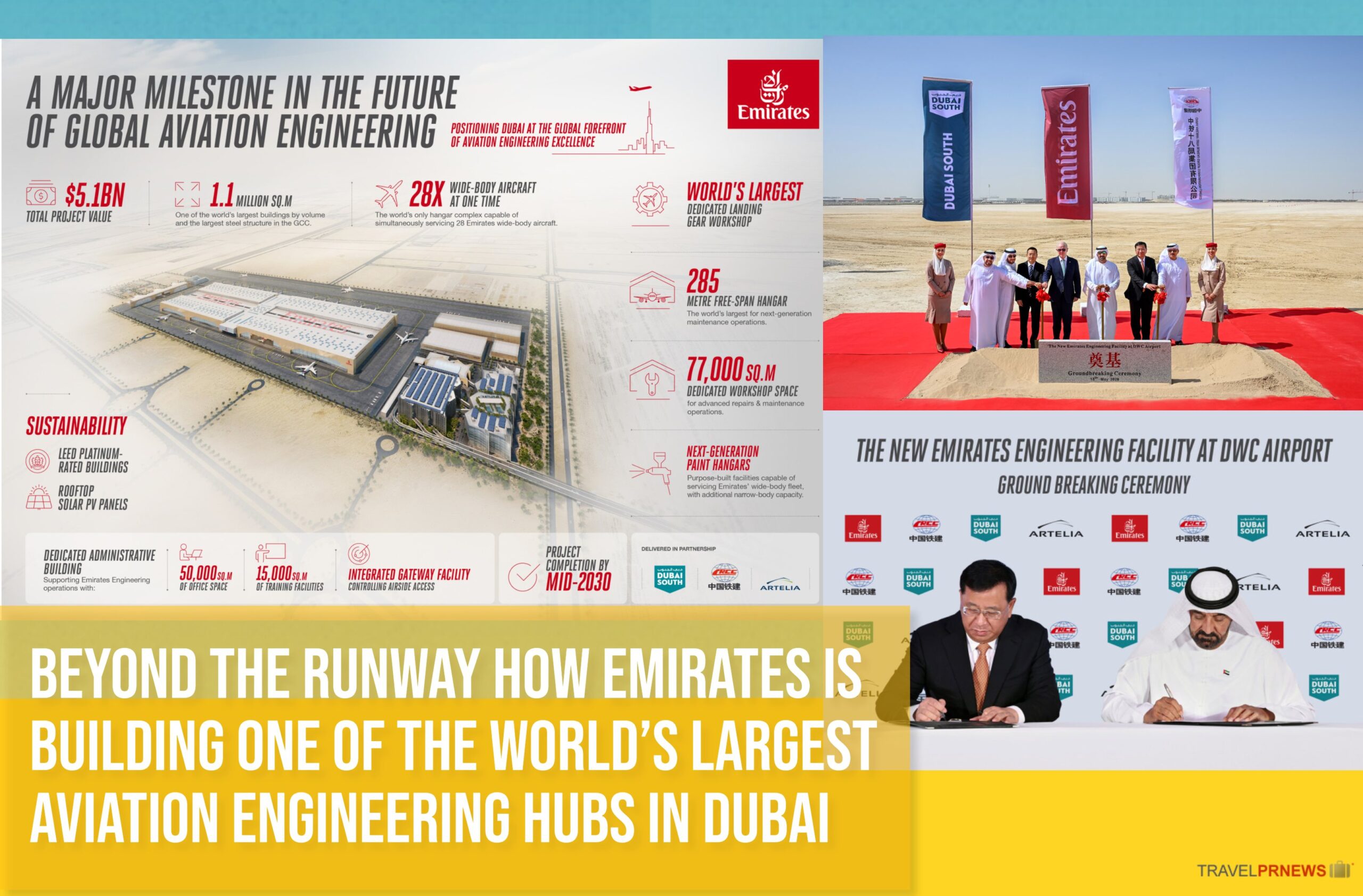
(NEWS) DUBAI, UAE, 2026-May-18 — /Travel PR News/ — Against the vast desert backdrop of Dubai South, where the outlines of tomorrow’s aviation ecosystem are steadily taking shape, the ceremonial turning of sand this week marked something far larger than the beginning of another infrastructure project. It was the latest signal that Dubai’s ambitions to dominate the future of global aviation are accelerating well beyond passenger terminals and luxury cabins — into the highly technical, often unseen world that keeps aircraft flying.
At the heart of that vision is a sprawling new engineering complex being built by Emirates near Al Maktoum International Airport, a facility that, once completed, is expected to become the world’s most advanced aviation maintenance, repair, and overhaul hub. According to details published in Emirates’ press release, the US$5.1 billion development will dramatically expand Dubai’s role not only as a gateway for travelers, but also as one of the aviation industry’s most strategically important technical centers.
For most travelers passing through Dubai, the city’s aviation identity is already inseparable from gleaming terminals, ultra-long-haul routes, and the near constant choreography of wide-body aircraft crossing continents. Yet behind the scenes lies a quieter infrastructure ecosystem that determines whether global air travel runs smoothly at all: hangars, engineering workshops, logistics hubs, component repairs, and fleets undergoing round-the-clock maintenance.
The new Emirates Engineering complex is designed to operate at a scale rarely seen in commercial aviation. Spanning roughly 1.1 million square meters, the facility is expected to become one of the world’s largest buildings by volume and the largest steel structure in the Gulf region. Its centerpiece will be a hangar system capable of simultaneously accommodating 28 wide-body aircraft — a staggering figure in an era when airlines worldwide are facing increasing pressure to maintain growing long-haul fleets efficiently.
The dimensions alone hint at the scale of the aviation future Dubai is preparing for. Plans include what is described as the world’s largest free-span aircraft hangar, stretching 285 meters wide, alongside the world’s largest dedicated landing gear workshop. There will also be two advanced aircraft paint hangars, vast logistics and storage facilities, and extensive repair workshops covering tens of thousands of square meters.
For aviation enthusiasts, the project reflects a broader shift underway in global air travel. As airlines increasingly seek greater operational independence and faster turnaround capabilities, many major carriers are investing heavily in vertically integrated engineering operations. Rather than relying extensively on third-party maintenance providers scattered across different regions, airlines are bringing more technical expertise, manufacturing capabilities, and specialist services under their own control.
That strategy was underscored during the groundbreaking ceremony attended by senior figures including Sheikh Ahmed bin Saeed Al Maktoum and Tim Clark. The new engineering base, they suggested, is intended not only to support Emirates’ own rapidly expanding fleet but also to strengthen Dubai’s position as a long-term aviation services powerhouse for the wider region.
The timing is significant. Global aviation is entering another major growth cycle, particularly across the Middle East and Asia, while manufacturers continue delivering increasingly sophisticated aircraft that require advanced technical infrastructure and highly specialized maintenance expertise. Airlines are also navigating mounting sustainability pressures, forcing engineering divisions to rethink everything from fuel efficiency and materials management to emissions reduction inside maintenance facilities themselves.
In Dubai South, sustainability has been woven directly into the project’s blueprint. The complex is targeting LEED Platinum certification, with solar panels planned across rooftops and new energy-efficiency standards integrated throughout the development.
The engineering hub also forms part of Dubai’s wider D33 economic agenda, a long-term strategy aimed at strengthening the emirate’s position as a global economic and logistics center. Around Al Maktoum International Airport — itself envisioned as one of the world’s largest future aviation hubs — an entire ecosystem of cargo operations, logistics facilities, aerospace businesses, and transport infrastructure continues to expand outward into the desert.
Construction of the engineering complex is being led by China Railway Construction Corporation, highlighting the increasingly global nature of aviation infrastructure development and the growing economic ties between the UAE and China.
For travelers, these developments may remain largely invisible. Few passengers boarding a long-haul flight pause to think about the immense technical ecosystem required to maintain modern aircraft fleets safely and efficiently. Yet facilities like this increasingly determine the reliability, sustainability, and resilience of global travel networks.
As Dubai continues building its identity not only as a destination but as a central nervous system for international aviation, projects like the new Emirates engineering campus reveal how the future of travel is being shaped as much inside maintenance hangars as inside airport lounges.
And in the desert south of the city, where cranes and steel structures are beginning to rise from the sand, that future is already under construction.
(IN SHORT) MGallery Collection has opened V Villas Maldives at Mirihi – MGallery Collection, marking…
(IN SHORT) Viking has introduced a wide range of new European river voyage experiences for…
(NEWS) HANNOVER, Germany, 2026-Jun-5 — /Travel PR News/ — TUI Group is highlighting new sustainability…
(NEWS) HANNOVER, Germany, 2026-Jun-5 — /Travel PR News/ — River cruise operators are increasingly experimenting…
(NEWS) SAN ANTONIO, TX, United States, 2026-Jun-5 — /Travel PR News/ — Sports partnerships increasingly…
(NEWS) TOKYO, Japan, 2026-Jun-5 — /Travel PR News/ — As airlines face increasing pressure to…