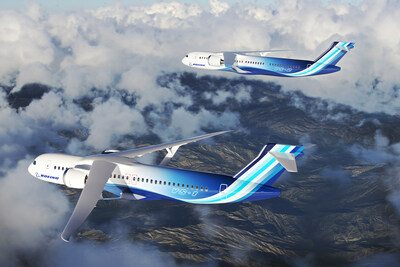
Boeing to Lead Development of Fuel-Efficient Transonic Truss-Braced Wing Demonstrator for NASA
ARLINGTON, Va., 2023-Jan-19 — /Travel PR News/ — NASA has selected Boeing [NYSE: BA] and its industry team to lead the development and flight testing of a full-scale Transonic Truss-Braced Wing (TTBW) demonstrator airplane.
The technologies demonstrated and tested as part of the Sustainable Flight Demonstrator (SFD) program will inform future designs and could lead to breakthrough aerodynamics and fuel efficiency gains.
When combined with expected advancements in propulsion systems, materials and systems architecture, a single-aisle airplane with a TTBW configuration could reduce fuel consumption and emissions up to 30% relative to today’s most efficient single-aisle airplanes, depending on the mission. The SFD program aims to advance the civil aviation industry’s commitment to reaching net zero carbon emissions by 2050, as well as the goals set forth in the White House’s U.S. Aviation Climate Action Plan.
“The SFD program has the potential to make a major contribution toward a sustainable future,” said Greg Hyslop, Boeing chief engineer and executive vice president of Engineering, Test & Technology. “It represents an opportunity to design, build and fly a full-scale experimental plane, while solving novel technical problems.”
Ultrathin wings braced by struts with larger spans and higher-aspect ratios could eventually accommodate advanced propulsion systems that are limited by a lack of underwing space in today’s low-wing airplane configurations. For the demonstrator vehicle, Boeing will use elements from existing vehicles and integrate them with all-new components.
NASA’s funding through the SFD Space Act Agreement totals $425 million. The SFD program will also leverage up to $725 million in funding by Boeing and its industry partners to shape the demonstrator program and meet the resource needs required. Separately, Boeing’s previous internal investments for recent phases of sustainable aviation research total $110 million.
The TTBW airframe concept is the result of more than a decade of development supported by NASA, Boeing and industry investments. Under previous NASA programs including the agency’s Subsonic Ultra Green Aircraft Research program, Boeing conducted extensive wind tunnel testing and digital modeling to advance the design of the TTBW. Early conceptual studies started under NASA’s Environmentally Responsible Aviation program.
Contact:
Boeing Media Relations
media@boeing.com
SOURCE: Boeing
###
(IN SHORT) Raffles Hotels & Resorts has opened Raffles Jeddah, a new luxury hotel on…
(NEWS) PARIS, France, 2026-May-25 — /Travel PR News/ — Long before the main draws begin at…
(IN SHORT) Four Seasons Hotel Madrid has introduced a renewed selection of Natura Bissé treatments…
(NEWS) BANGKOK, Thailand, 2026-May-25 — /Travel PR News/ — Twenty-five years ago, Anantara Hotels & Resorts…
(NEWS) BANGKOK, Thailand, 2026-May-25 — /Travel PR News/ — For many luxury hotels, anniversaries are marked…
(NEWS) SYDNEY, Australia, 2026-May-22 — /Travel PR News/ — As winter settles over Sydney Harbour, the…