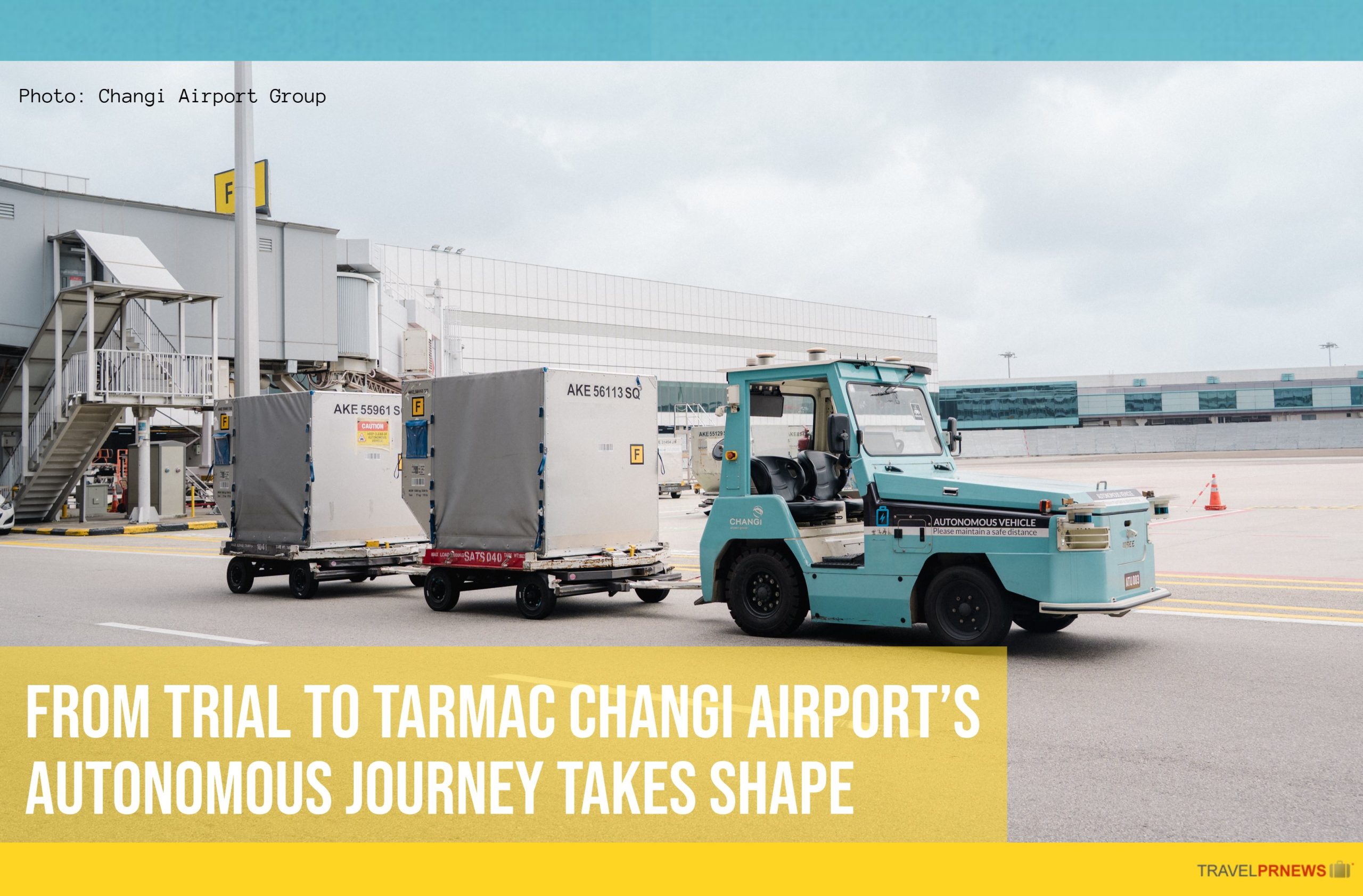
(NEWS) SINGAPORE, 2026-Jan-20 — /Travel PR News/ — Changi Airport has taken another step toward redefining the airport of the future, with fully driverless autonomous tractors now operating live on its airside to transport passenger baggage. Based on details shared through official announcement, the deployment follows nearly a year of intensive testing and signals a shift toward smarter, more automated ground operations as the airport prepares for long-term growth.
After completing more than 5,000 test trips, the autonomous tractors are now transferring baggage between Terminal 1 and Terminal 4 without a driver on board. Equipped with an array of sensors and cameras, the vehicles are designed to navigate the complexity of the airside environment around the clock, operating safely in daylight, darkness and adverse weather. While fully autonomous, each tractor is remotely supervised from a control centre, allowing operators to intervene instantly if required.
The rollout forms part of Changi Airport’s broader “airside of the future” vision, which blends automation, artificial intelligence and redesigned work processes. Additional autonomous tractors are set to be introduced later this year on routes linking Terminal 2 with aircraft stands, supporting baggage operations under a collaboration between Changi Airport Group and SATS. By 2027, the fleet is expected to expand to 24 vehicles, with future applications extending beyond baggage to include cargo and equipment towing.
Beyond operational efficiency, the project reflects a deliberate approach to workforce transformation. By removing routine driving tasks, autonomous tractors allow airside staff to focus on last-mile operations that remain difficult to automate. Clear markings and labelling have been introduced across the airside to ensure that autonomous vehicles and human-operated equipment can operate safely alongside one another.
The initiative aligns with Singapore’s wider aviation innovation agenda and has been co-funded by the Civil Aviation Authority of Singapore. As Changi scales up to meet the demands of Terminal 5 in the mid-2030s, technologies such as autonomous vehicles are expected to play a central role in boosting productivity while reshaping job scopes across the ground handling sector.
Industry partners have positioned the deployment as both a technological and human milestone. Alongside improvements in turnaround efficiency and baggage reliability for travellers, the project is being used as a testbed for new operating models, safety protocols and training programmes that support workers transitioning into higher-skilled, higher-value roles. In this way, Changi’s driverless tractors represent not just a change in how baggage moves, but a broader evolution in how airports operate and how aviation jobs are defined for the future.
Changi’s move also places it within a broader global shift toward autonomous ground handling, where airports in Asia have increasingly served as testing grounds for advanced airside technologies. Earlier deployments at airports such as Tokyo Narita demonstrated that autonomous towing tractors could operate safely in complex, restricted airside environments alongside aircraft, vehicles and ground staff. Those early trials helped establish confidence in automated driving systems under real-world conditions and paved the way for live operations, reinforcing the idea that autonomy is no longer experimental but an emerging operational standard at major hubs.
More recently, large-scale trials at Hong Kong International Airport have expanded the scope of autonomous ground vehicles beyond baggage to include complex cargo workflows. Autonomous electric tractors there have successfully navigated long airfield routes, executed precise docking manoeuvres and integrated with digital security systems, while also supporting emissions reduction through electrification. Together, these developments highlight a clear industry trajectory — one where airports combine automation, sustainability and workforce transformation. Against this backdrop, Changi’s live deployment represents a natural next step, positioning the airport not only as an early adopter but as a reference point for how autonomous airside operations can be scaled safely and responsibly.
As global air travel continues to evolve, Changi Airport’s autonomous tractor programme signals a broader rethinking of how airports operate behind the scenes. By pairing advanced automation with careful workforce redesign and long-term planning for Terminal 5, the airport is positioning itself for growth without compromising safety or service quality. In doing so, Changi is not just streamlining baggage movement on the airside, but laying the groundwork for an airport ecosystem where technology and human expertise work in tandem — setting a template for how major hubs worldwide may navigate the next chapter of aviation.
London, United Kingdom, 2026-Mar-13 — /Travel PR News/ — The Long Run will be hosting its…
Zambia, 2026-Mar-13 — /Travel PR News/ — Travel Promoters is delighted to share its appointment as…
(IN SHORT) dnata is expanding its cargo operations at Zurich Airport with a new purpose-built…
(IN SHORT) Wizz Air is expanding its base at Venice Marco Polo Airport by adding…
(IN SHORT) Minor Hotels has launched a new luxury hospitality brand called The Wolseley Hotels,…
(IN SHORT) Four Seasons Hotel des Bergues Geneva is undergoing a carefully phased renovation that…